A classroom may look modern from the outside — smart boards, proper lighting, comfortable seating, and advanced infrastructure.
But if students cannot hear properly, learning automatically becomes difficult.
One of the most overlooked challenges in schools today is poor classroom acoustics. Background noise, sound echo, outside disturbances, and unclear teacher communication can significantly affect concentration levels inside the classroom.
In many cases, students sitting at the back struggle to hear instructions clearly. Teachers often need to repeat themselves multiple times. Over time, this not only affects learning outcomes but also creates mental fatigue for both students and educators.
This is why modern educational institutions are now focusing on classroom acoustics as an important part of classroom design and student engagement.
Because a good classroom is not just seen.
It should also be heard clearly.
What are Classroom Acoustics?
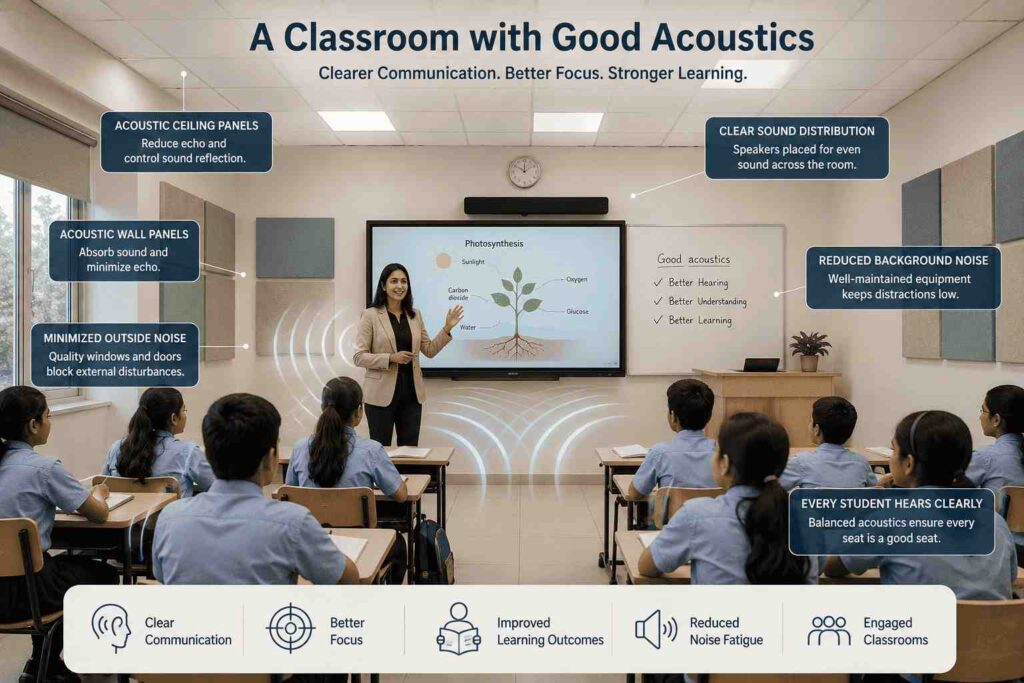
Classroom acoustics refers to how sound behaves inside a classroom environment.
It includes:
- How clearly students can hear the teacher
- How sound travels across the room
- How much echo exists
- How much external noise enters the classroom
A classroom with poor acoustics often creates:
- Unclear communication
- Student distraction
- Reduced focus
- Lower classroom participation
On the other hand, classrooms with proper acoustic management create a more comfortable and effective learning experience for everyone.
Why Classroom Acoustics Matter in Schools?
Teaching is heavily dependent on communication.
If students miss even a few words repeatedly during lectures, their understanding of concepts gradually weakens. This becomes even more critical in subjects that require deep attention, such as science, mathematics, and language learning.
Good classroom acoustics help:
- Students understand lessons more clearly
- Improve concentration levels
- Reduce misunderstandings
- Increase classroom interaction
- Support better academic performance
It also benefits teachers by reducing vocal strain from speaking loudly throughout the day.
In simple words, when students hear better, they learn better.
5 Common Problems That Affect Classroom Acoustics
Many schools unknowingly face acoustic challenges because classroom design is often focused more on visual infrastructure than sound management.
Here are some common issues that affect classroom acoustics:
1. Excessive Echo Inside Classrooms
Large empty walls, tiled floors, and hard surfaces reflect sound continuously, creating echo and unclear speech.
2. External Noise Disturbance
Traffic noise, playground activities, corridor movement, or nearby construction can interrupt classroom focus.
3. Poor Classroom Layout
Improper seating arrangements or oversized classrooms often make it difficult for students sitting farther away to hear properly.
4. Noise from Fans and Equipment
Old ceiling fans, projectors, air conditioning systems, or laboratory equipment can create constant background noise.
5. Overcrowded Learning Spaces
When too many students are present in a classroom, noise levels naturally increase, affecting communication clarity.
The Role of Classroom Design in Acoustic Performance
Classroom acoustics and classroom design are deeply connected.
A poorly planned room can create communication barriers even if the teaching quality is excellent.
Modern educational infrastructure now considers:
- Room dimensions
- Ceiling height
- Furniture positioning
- Material selection
- Sound absorption techniques
while designing classrooms.
This is especially important in:
- Smart classrooms
- STEM learning spaces
- Seminar halls
- Language labs
- Activity-based classrooms
Educational institutions are gradually realising that learning environments should support both visual and auditory comfort.
6 Practical Ways to Improve Classroom Environment
Improving classroom acoustics does not always require expensive reconstruction. Small infrastructure and design improvements can make a major difference.
1. Use Acoustic Wall Panels
Acoustic panels help absorb excess sound reflections and reduce echo inside classrooms.
2. Install Sound-Absorbing Materials
Curtains, notice boards, soft boards, and acoustic ceiling materials help control sound bounce.
3. Improve Classroom Furniture Layout
Proper desk arrangement ensures sound travels evenly across the room.
4. Reduce External Noise Entry
Using quality doors, windows, and partitions can minimize outside disturbances.
5. Use Ergonomic Classroom Design
Modern classroom layouts designed with acoustic considerations naturally create better sound distribution.
6. Maintain Equipment Regularly
Repairing noisy fans, projectors, and air-conditioning systems helps reduce constant background sound.
How Better Acoustics Improve Student Engagement?
Student engagement increases significantly when communication becomes clearer.
When students can hear properly:
- They participate more confidently
- Ask questions comfortably
- Stay attentive longer
- Interact more actively during discussions
Teachers also experience smoother classroom management because instructions do not need constant repetition.
This creates a more positive classroom environment where teaching becomes more interactive instead of stressful.
Conclusion
A classroom should be a place where ideas are heard clearly, discussions happen comfortably, and learning feels effortless.
But when noise, echo, and poor sound clarity become constant barriers, even the best teaching methods lose effectiveness.
Improving classroom acoustics is not simply about reducing noise. It is about improving communication, concentration, and overall student learning experiences.
As schools continue building future-ready learning environments, classroom acoustics will play an increasingly important role in shaping how students learn, interact, and grow inside the classroom.








Leave a Reply