Table of Contact
- What are the requirement of the Industrial Laboratory?
- What are the requirements of the University laboratory?
- Industrial Labs Are Designed Around Processes
- University Labs Are Designed Around Users
- Utility Planning Is Usually More Equipment-Specific
- Future Expansion Is More Closely Connected to Industrial Operations
- Industrial Lab vs University Lab: Key Differences
- Conclusion
Do you ever wonder what the difference between an academic Laboratory and Industrial Laboratory is? These laboratories may look similar at first glance, but the purpose behind their design can be completely different. An Industrial Lab is generally created to support manufacturing, quality control, product development, testing, validation, and commercial research. However, a university laboratory, on the other hand, primarily supports teaching, student experiments, academic research, and skill development.
Because their objectives differ, the way these laboratories are planned, equipped, furnished, and operated also changes significantly. In this blog, you will discuss these differences before beginning any laboratory setup project.
What are the requirement of the Industrial Laboratory?
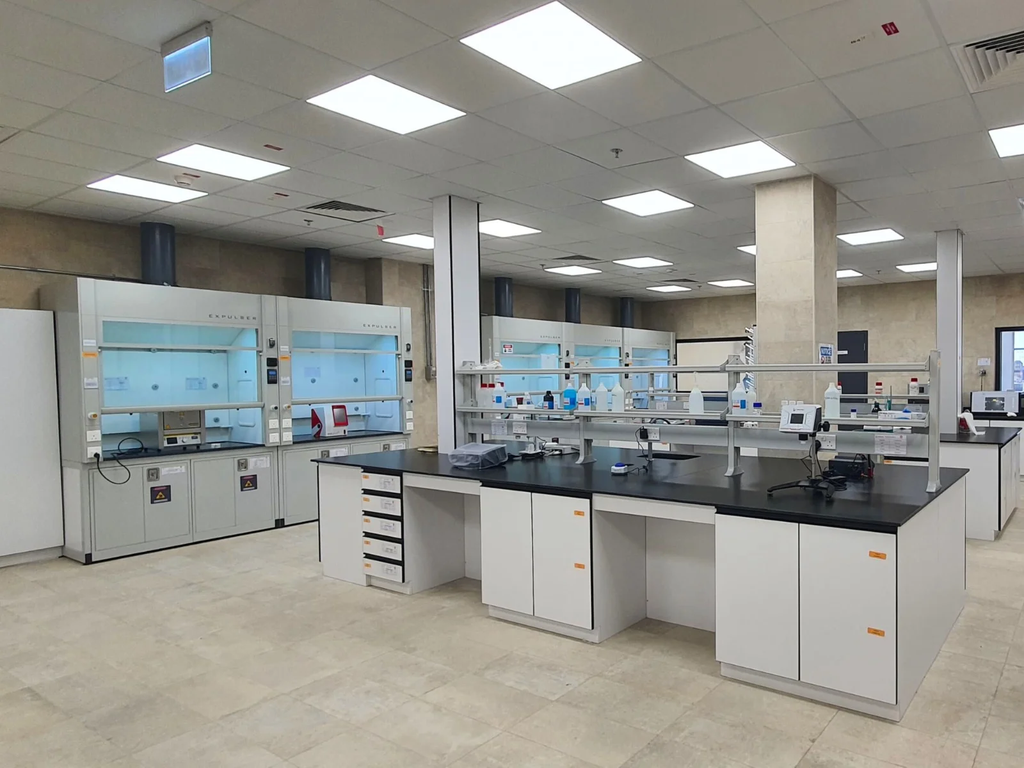
The requirement of an industrial laboratory depends on the type of testing, manufacturing process, and equipment used. However, most industrial laboratories need the following essentials components:
- Appropriate Laboratory Layout: The space should be divided according to activities such as sample preparation, wet chemistry, instrumental analysis, testing, storage, washing, and waste handling. The layout should support smooth movement of personnel, samples, chemicals, and equipment.
- Dedicated Laboratory laboratory: Workbenches should be selected according to the load, chemicals, heat, vibration and specific equipment. However, Industrial Labs need more heavy-duty workstations.
- Chemical-resistant work surfaces: Worktops should suit the laboratory application. Depending on the process, laboratories may use granite, GI, or stainless that are devoid of heat and Chemicals.
- Ventilation and containment: Laboratories handling hazardous chemicals, fumes or biological materials may require fume hoods, local exhaust ventilation, biosafety cabinets, or other containment systems appropriate to the process.
- Ergonomic and accessible workspaces: Industrial laboratories should ideally use flexible utility system and modular furniture so additional instruments workstations or testing activities.
What are the requirements of the University laboratory?
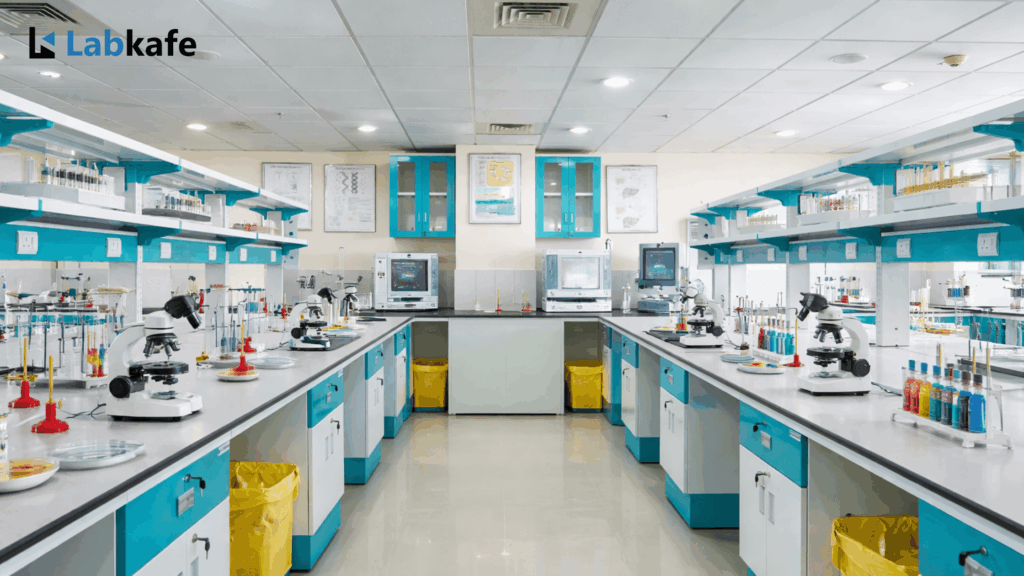
A university laboratory is designed mainly for academic purposes and experiment demonstrations; students experiment and academic research.
- Dedicated Student Workstations: The laboratory should provide enough bench space for students to perform experiments comfortably without overcrowding the workstations.
- Educator-friendly laboratory layout: The required layout should allow clear movement between benches and provide good visibility of the instructor, demonstration area, and lab equipment.
- Essential utility connections: Electrical points, water supply, sinks, gas lines, drainage, and data connections should be positioned according to the subjects and experiments carried out in the laboratory.
- Safe chemical and material storage: Chemicals, glassware, specimens, instruments, and consumables should have dedicated storage areas. Hazardous or incompatible chemicals should be stored separately.
Industrial Labs Are Designed Around Processes
Industrial lab is designed for the testing, analysis and quality control that takes place inside it. Instead of starting with furniture placement, the planning process begins by understanding how work will move through the laboratory.
Sample and Material Flow in Industrial laboratory
Planners first consider how samples enter the lab, where they are prepared, how they move between testing areas, and where they are stored or disposed of after analysis. A clear flow helps reduce unnecessary movement and cross-contamination.
Restricted Laboratory Activities in Industrial laboratory
Some laboratory processes need physical separation. Sample preparation, chemical handling, sensitive instrument analysis, washing, and waste handling may create dust, fumes, vibration, moisture, or contamination.
However, proper zoning keeps these activities from affecting each other. It also helps laboratories maintain a more controlled working environment.
Storage System in Industrial lab in Industrial laboratory
An industrial lab requires a well-planned storage system to keep chemicals, samples, glassware, tools, consumables, documents, and testing materials organized and easily accessible. Storage should be placed close to the work area it supports so that laboratory personnel can access frequently used items without unnecessary movement. However, Industrial laboratories may also require specialized storage for hazardous or sensitive materials. Flammable substances, corrosive chemicals, reference samples, and other incompatible materials should be stored in suitable dedicated cabinets instead of general-purpose storage.
University Labs Are Designed Around Users
A university laboratory is planned around the needs of students, teachers, researchers, and technical staff who use the space regularly. Unlike an industrial lab, where the layout mainly follows a specific testing or production process, a university lab must support teaching, demonstrations, practical experiments, group activities, and research within the same environment. However, the designs therefore need to provide enough workstations, clear circulation paths, good visibility of the instructor, and convenient access to shared equipment and utilities.
However, the laboratory should also accommodate different levels of users, from undergraduate students carrying out basic experiments to researchers working with more advanced instruments. Although, flexible workbenches, accessible storage and clearly organized teaching and research zones help make the laboratory easier and safer to use. A user-focused layout also allows instructors to supervise students effectively while giving learners enough space to perform experiments comfortably.
Utility Planning Is Usually More Equipment-Specific
In an industrial laboratory, utility planning is closely linked to the equipment installed in each work area. Furthermore, different instruments may require dedicated electrical loads, water supply, drainage, gas lines, compressed air, vacuum connections, data ports, or controlled ventilation. These requirements should be identified before finalizing the laboratory layout so that every workstation receives the services it actually needs.
For example, analytical instruments may need stable power and data connections, wet chemistry areas may require water and drainage, while certain testing equipment may depend on compressed air or specialty gases. Planning utilities around equipment helps reduce exposed cables, long pipelines, and costly modifications after installation. It also makes future maintenance and equipment upgrades easier.
Future Expansion Is More Closely Connected to Industrial Operations
In an industrial laboratory, future expansion is often directly linked to production growth, new testing requirements, additional product lines, and the introduction of advanced instruments. As industrial operations expand, the laboratory may need more workstations, additional storage, higher utility capacity, or new testing zones to support increased workloads.
For this reason, industrial labs are often planned with flexibility in mind. Modular furniture, accessible utility lines, adaptable storage, and provision for additional equipment can make future upgrades easier. A flexible layout allows the laboratory to grow with the operation without requiring a complete redesign every time processes or testing requirements change.
Industrial Lab vs University Lab: Key Differences
| Areas | Industrial Laboratory | University laboratory |
| Primary Purpose | Quality Testing, Quality Assurance, product development, Production Support, and Research | Teaching, Demonstration, Academic Demonstrations and Academic experiments |
| Design Approach | Long Process-driven | User and Learning Driven |
| Layout Planning | The layout is based on sample flow, testing sequence and operational workflow | Based on the capacity of the student, supervision, movement, and Educator activities |
| Laboratory furniture | Often Application specific, heavy-duty, chemical-resistant, or equipment focused | Usually flexible, durable, and suitable for repeated student use |
| Laboratory Equipment | Specific Equipment that are used for industrial purposes | Selected according to curriculum, teaching requirements, and research needs |
| Storage | May require dedicated chemical, sample, hazardous material, and industrial storage systems | Often focuses on glassware, chemicals, experiment kits, teaching materials, and student resources |
Conclusion
Industrial and university laboratories serve different purposes, so their layouts, furniture, utilities, storage, and equipment should be planned accordingly. However, an industrial lab focuses more on process efficiency, testing requirements, specialized equipment, and operational growth, while a university lab focuses on teaching, student usability, supervision, practical learning, and academic research.
Whether you are planning an industrial testing facility or an academic laboratory, the right design should support your actual workflow and future requirements.






Leave a Reply