Table of Contents
- Understanding CBSE Laboratory Requirements for Class 11 & 12
- CBSE Biology Lab Equipment List for Class 11 & 12
- CBSE Chemistry Lab Equipment List for Class 11 & 12
- CBSE Physics Lab Equipment List for Class 11 & 12
- Lab Safety Equipment Every School Must Have
- How to Choose the Right Lab Equipment for Schools
- Conclusion
A science laboratory is not just another room in a school; it is where theories come to life. However, Students may read about plant tissues, electricity, or chemical reactions in textbooks, but true understanding happens when they perform experiments with the right Lab Equipment. However, for CBSE-affiliated schools, maintaining well-equipped science laboratories is not only important for student learning but also necessary for smooth practical examinations and institutional compliance, whether it is science lab apparatus, understanding and practical confidence among students.
If your school is planning a new laboratory or upgrading an existing one, this guide provides a complete list of lab apparatus for CBSE practicals in Classes 11 & 12.
Understanding CBSE Laboratory Requirements for Class 11 & 12
CBSE practical education focuses heavily on experimentation, observation, and application-based learning. During Classes 11 and 12, students are expected to conduct experiments independently, observe results accurately, and maintain practical records. This means schools must maintain well-equipped laboratories with functional apparatus, scientific models, measuring instruments, chemicals, and safety essentials.
A properly organised science laboratory helps schools:
- Conduct practical exams smoothly
- Meet CBSE laboratory requirements
- Improve student performance in practical assessments
- Encourage inquiry-based learning
- Build confidence through real-world experimentation
While all three science disciplines are equally important, the nature of the required equipment names differs depending on the subject.
CBSE Biology Lab Equipment List for Class 11 & 12
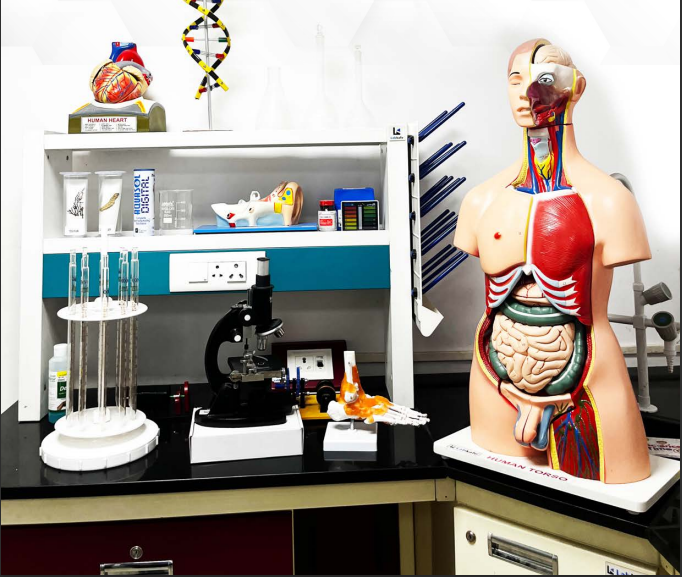
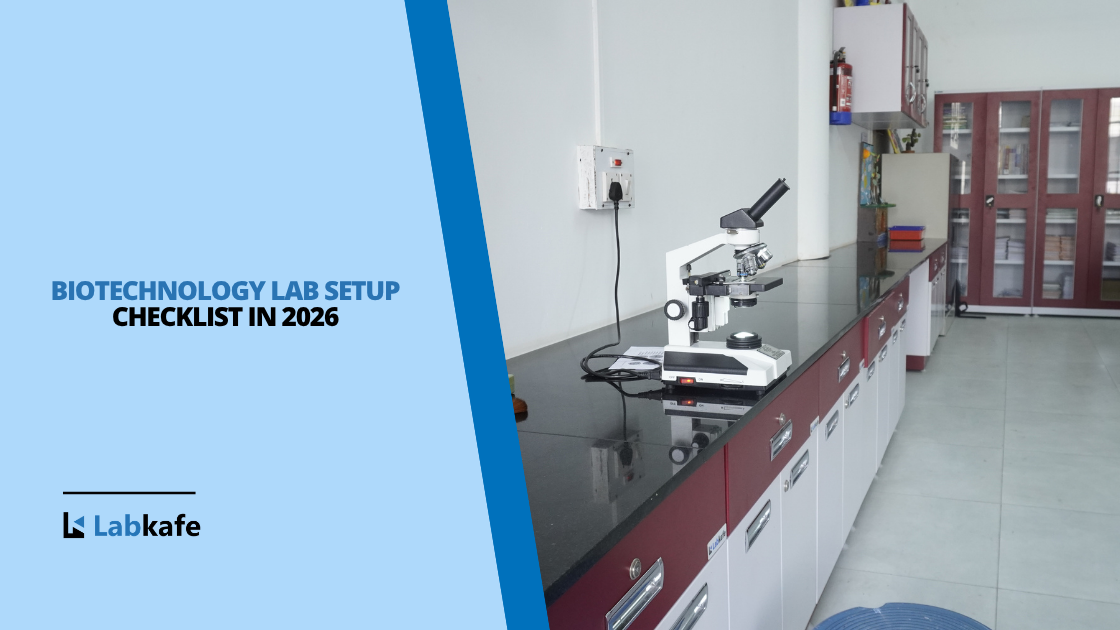
Biology experiments in CBSE Class 11 and 12 are highly observation-based, making quality biology apparatus essential for effective learning. At the core of every biology laboratory is the Compound Microscope, one of the most important pieces of Lab Instrument that helps students observe plant tissues, microorganisms, blood cells, bacteria, and temporary slides in detail. From studying onion peel cells to understanding cell division, microscopes transform textbook concepts into hands-on experiences.
Along with microscopes, biology labs require glassware and experimental tools such as beakers, test tubes, petri dishes, pipettes, measuring cylinders, and droppers for practical experiments and specimen observation. Schools also benefit from educational models like DNA structures, skeleton models, and anatomy charts that simplify complex concepts. Additionally, dissection kits, preserved specimens, and permanent slides help students better understand biological structures, making practical sessions more engaging and interactive.
CBSE Chemistry Lab Equipment List for Class 11 & 12
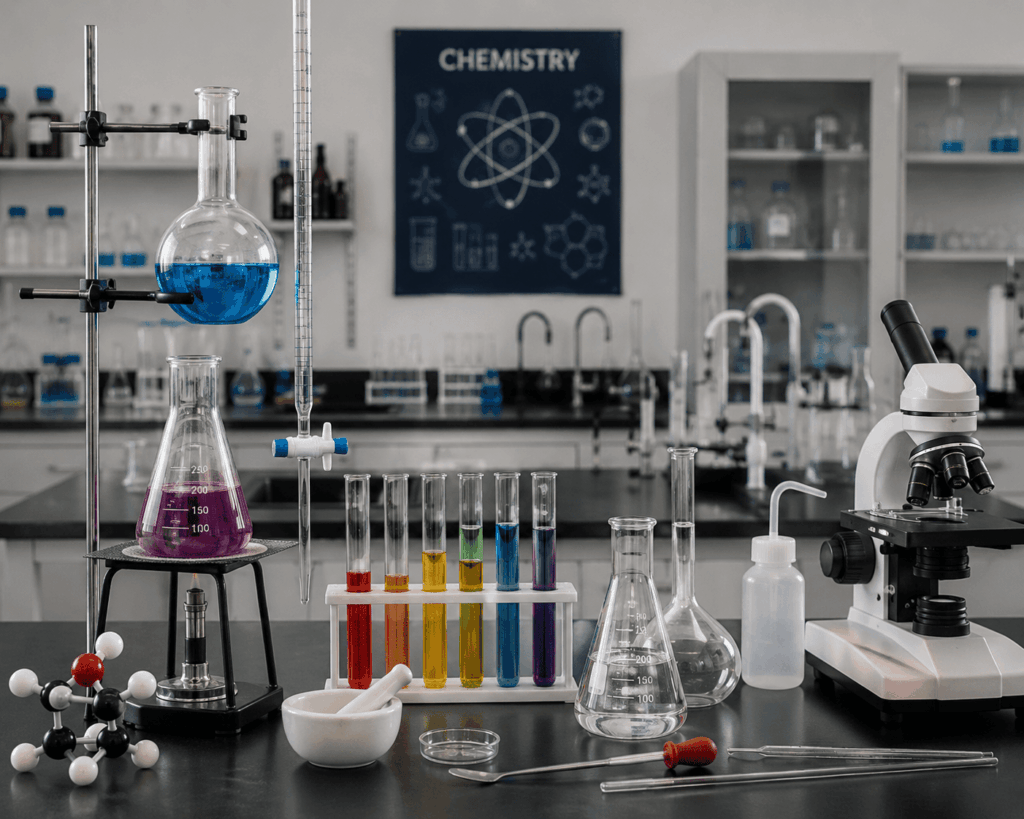
Unlike biology, chemistry practicals are experiment-intensive and require greater emphasis on measurement, reactions, and precision. This is where durable and reliable chemistry lab apparatus becomes essential.
Chemistry laboratories generally include glassware such as beakers, conical flasks, burettes, pipettes, measuring cylinders, reagent bottles, and test tubes for experiments related to salt analysis, titration, and solution preparation.
Apart from glassware, schools also require apparatus such as spirit lamps or Bunsen burners, tripod stands, wire gauze, clamp stands, pH meters, funnels, and digital weighing balances. Since Class 11 and 12 chemistry practicals involve both physical and organic chemistry experiments, schools must maintain properly organized laboratory stations for smooth practical execution.
CBSE Physics Lab Apparatus List for Class 11 & 12
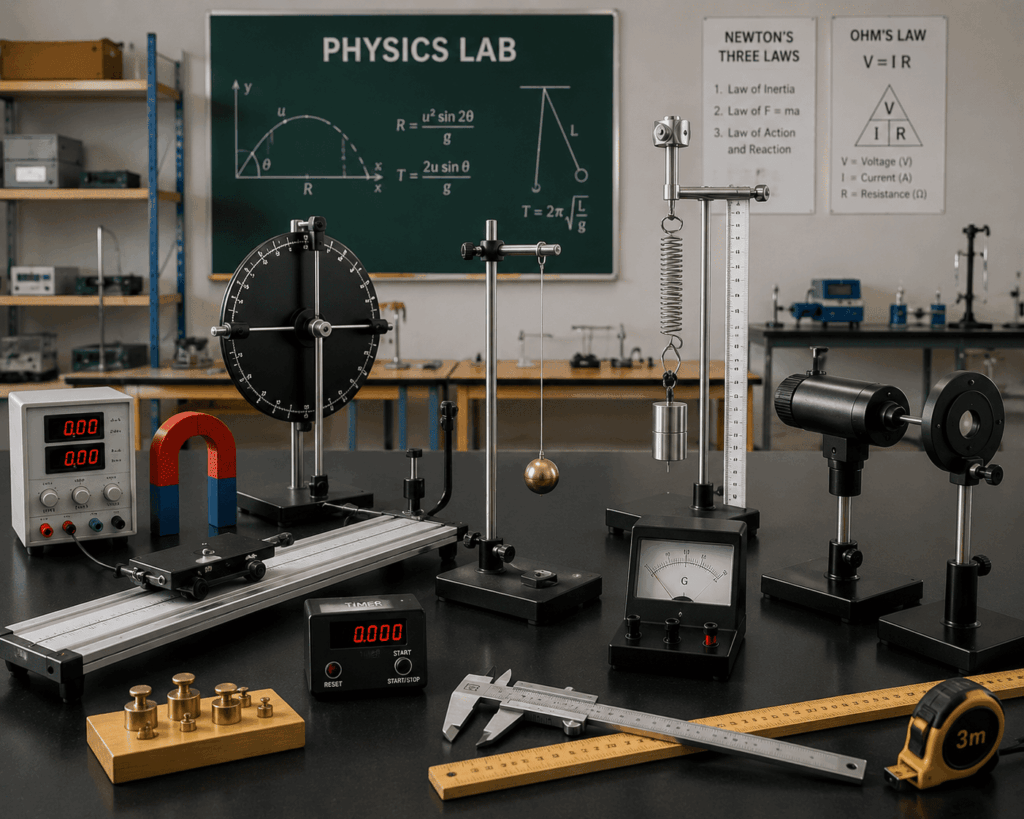
While biology focuses on observation and chemistry emphasizes reactions, physics lab equipment revolves around precision, measurements, and experimentation. However, students studying Class 11 and 12 physics often perform experiments involving optics, electricity, mechanics, and motion. Instruments such as vernier callipers, screw gauges, spring balances, pendulum setups, optical benches, mirrors, lenses, galvanometers, ammeters, and voltmeters are commonly used during practical classes.
These instruments allow students to understand concepts such as resistance, reflection, measurement, and motion through direct experimentation rather than theoretical assumptions.
Lab Safety Equipment Every School Must Have
One of the most overlooked aspects of school laboratories is safety.
Even the most advanced apparatus becomes ineffective if proper safety standards are ignored. Science practical involve chemicals, glassware, sharp tools, and electrical instruments, which makes student safety a priority.
Schools should maintain safety essentials such as lab coats, gloves, goggles, first aid kits, fire extinguishers, and proper chemical storage systems. A safe laboratory environment not only reduces risks but also encourages students to perform experiments more confidently.
How Schools Can Choose the Right Lab Equipment
Buying laboratory apparatus should never be approached as a one-time purchase, it is an investment in long-term education quality.
Schools planning new laboratories should prioritise durable, curriculum-aligned, and student-friendly apparatus that supports CBSE practical requirements. Choosing trusted suppliers ensures better quality, longer usability, and improved practical experiences for students.
Many institutions now prefer complete science lab setups, sourcing biology lab equipment, chemistry lab equipment, and physics lab equipment together to maintain consistency and avoid procurement challenges.
Conclusion
A school laboratory is more than a room filled with instruments—it is where curiosity becomes learning.
For schools striving to create impactful science education experiences, investing in high-quality laboratory infrastructure is essential. A well-equipped science lab encourages hands-on learning, strengthens scientific concepts, and inspires curiosity among students. From conducting experiments to developing analytical thinking, laboratories play a crucial role in shaping future doctors, scientists, engineers, and innovators. Create a future-ready learning environment with advanced lab solutions: get in touch with us today to build your ideal school laboratory.






Leave a Reply