A laboratory thermometer is one of the most essential lab instruments used in school science labs, research laboratories, and educational experiments. It helps accurately measure the temperature of chemicals, liquids, and other substances during heating, cooling, and observation activities.
Unlike clinical thermometers that measure human body temperature, laboratory thermometers are designed for a much wider temperature range and are commonly used in physics, chemistry, and biology laboratories.
In this guide, you will learn:
- Laboratory thermometer diagram
- Range and least count
- Uses and functions
- Working principle
- Differences between laboratory and clinical thermometers
- How to read a laboratory thermometer correctly
Laboratory Thermometer Diagram

Definition of Laboratory Thermometer
Laboratory thermometers measure the temperature of substances in lab settings, not the human body. They help regulate temperature for experiments or controlled environments. After measuring the temperature of the solution with the lab thermometer, the solution is heated or cooled for the experiment accordingly. These thermometers determine melting, boiling, and freezing points and monitor sample or equipment temperatures.
A basic lab thermometer has a glass tube with a bulb containing mercury or alcohol. This liquid must be visible, expand uniformly, and have a low freezing point for accuracy. Lab thermometers ensure speed, precision, and safety in experiments.
A separate thermometer is needed because clinical thermometers are designed for human body temperature ranges, while lab thermometers handle a much wider range for scientific use.
Laboratory Thermometer: Range
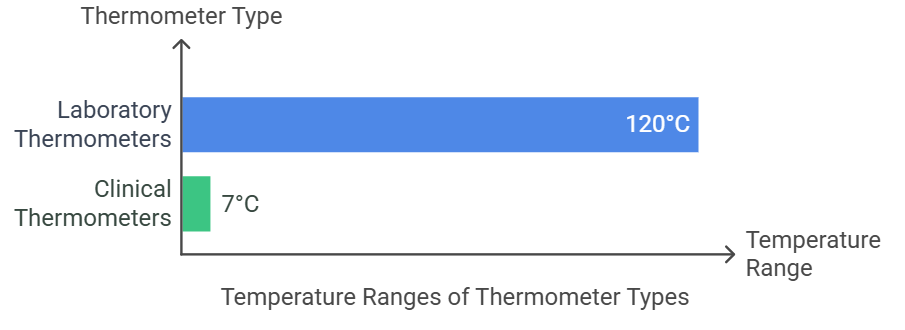
Laboratory thermometers range from -10˚C to 110˚C (Range 120˚C). Clinical Thermometers range from 35˚C to 42˚C (Range 7˚C). Clinical thermometers have a much narrower range than lab thermometers, because lab thermometers measure solutions across a wide range of temperatures in lab experiments. They measure human body temperature, which never crosses a certain range of temperature. Hence, wide ranges are unnecessary.
Laboratory Thermometer: Uses
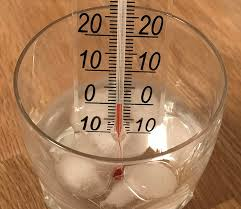
- Measuring boiling and freezing points during chemistry experiments
- Monitoring temperatures in school laboratory demonstrations
- Measuring solvents and chemical solutions accurately
- Conducting physics and biology practical activities
- Supporting safe heating and cooling procedures in laboratories
What is the Function of a Laboratory Thermometer?
A laboratory thermometer measures the boiling and freezing points in science experiments. It is also used to determine the temperature of various substances. Its temperature range extends from -10 degrees Celsius to 110 degrees Celsius.
What is the Difference Between A Laboratory and A Clinical Thermometer?
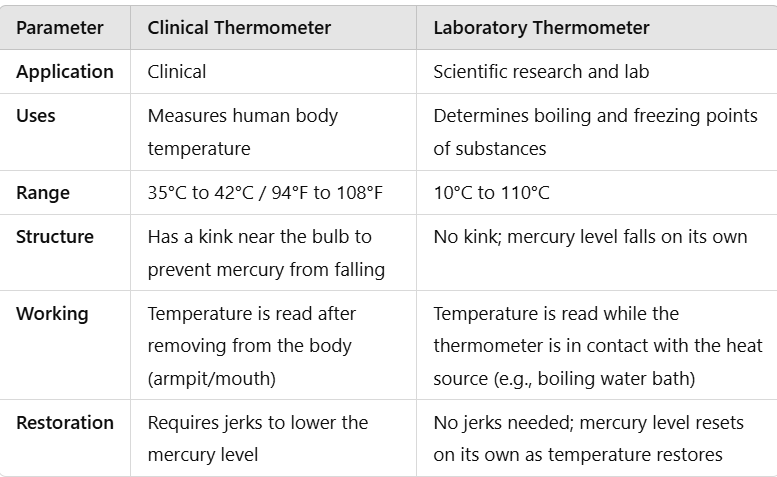
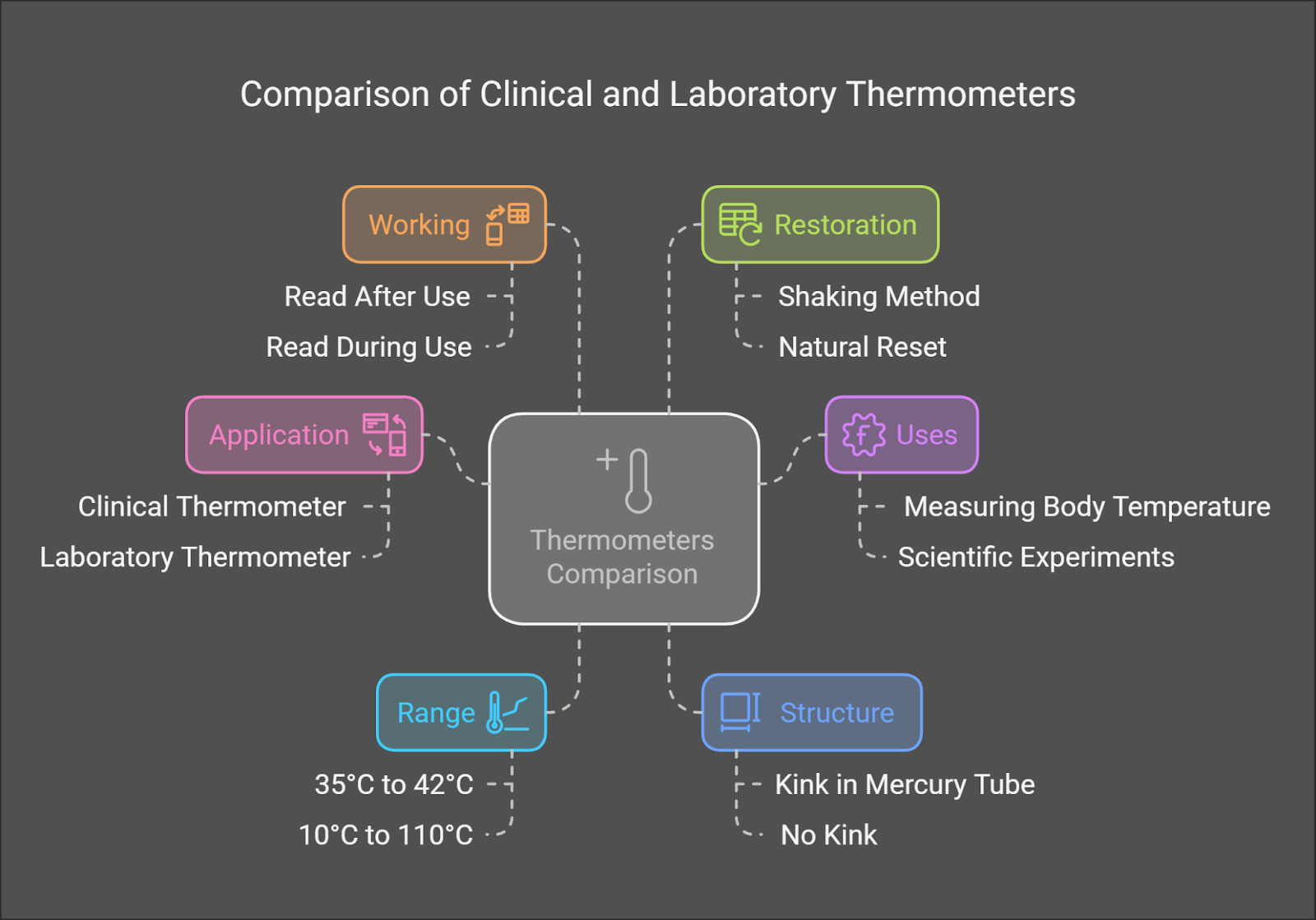
The table and figure below outline the differences between laboratory and clinical thermometers in detail.
Why Can’t Clinical Thermometers be used in Laboratories?
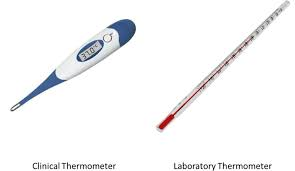
Laboratory thermometers are designed to withstand extreme temperatures and harsh conditions, making them suitable for use in labs. They provide accurate readings of temperature in solutions, environments, or surroundings. For example, when immersed in water baths with temperatures above the boiling point of water, laboratory thermometers can endure high heat without breaking. In contrast, clinical thermometers, which are designed for measuring body temperature, can break or leak mercury when exposed to such high temperatures. Therefore, laboratory thermometers are more durable and capable of handling the demands of high-temperature environments.
Types of Laboratory Thermometers
The types of laboratory thermometers commonly used are:
- Liquid-in-Glass Thermometer
- Glass stem with a bulb containing mercury or alcohol.
- Mercury expands or contracts with temperature changes.
- Alcohol thermometers are safer as they don’t contain toxic mercury.
- Infrared Thermometer
- Focuses infrared energy onto a detector that converts it into temperature.
- Ideal for measuring surface temperatures from a distance.
- Bimetallic Strip Thermometer
- Consists of two bonded metals with different temperature coefficients.
- Converts temperature into mechanical displacement.
- Used for high-temperature control in industries.
- Thermistor
- Electronic device whose resistance varies with temperature.
- Converts resistance change into temperature change.
- Ideal for precise measurements in experimental work.
- Constant Pressure Gas Thermometer (CPGT)
- Uses nitrogen gas and operates at constant pressure and volume.
- More accurate and sensitive than liquid-in-glass thermometers.
- Used to calibrate other thermometers.
- Thermocouple
- Consists of two different metals with hot and cold junctions.
- Voltage is generated based on the temperature difference.
- Can measure very high (up to 2300 K) and low (down to 500 K) temperatures.
- Pyrometer
- Measures temperature based on radiation emitted from an object.
- Includes an optical system and detector.
- Used for high-temperature applications like furnaces, without contacting the object.
Laboratory Thermometer Working: Explanation
Laboratory thermometers use mercury or alcohol as the substance to indicate temperature. The substance is held in the bulb of the thermometer, which is immersed in the liquid to be measured. As heat is applied, the liquid heats up, causing the mercury or alcohol to expand and rise up the tube. The capillary tube is graduated, showing the rise in temperature in degrees as the substance expands. This allows the temperature to be measured accurately.
How to Read a Laboratory Thermometer?
Here are the steps for using a laboratory thermometer:
- Check the Range: Ensure the thermometer’s range is suitable for the temperature measurement required in your experiment.
- Identify the Least Count: The smallest division on the thermometer is the least count. A lower least count indicates higher precision.
- Immersion: Secure the thermometer with a clamp and stand, immersing the bulb completely in the liquid. Make sure the bulb doesn’t touch the container’s walls or bottom.
- Observe the Rise: Note the rise in the capillary tube. When the rise stops, wait for a few minutes.
- Final Temperature: After waiting, read the final temperature of the liquid.
<<For clear demonstration, watch this video >>
Frequently Asked Questions (FAQs)
Lab thermometers can have either, though alcohol is safer as it’s non-toxic.
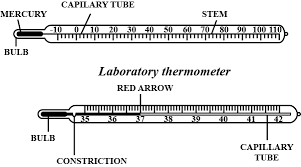
Laboratory thermometers DO NOT HAVE KINKS. Kinks are a feature of clinical thermometers, where they prevent the mercury from falling back too quickly, allowing enough time to read the patient’s body temperature. In contrast, laboratory thermometers measure the temperature of solutions with continuously changing temperatures, so kinks are unnecessary. The mercury in laboratory thermometers does not fall back completely into the bulb, which ensures a continuous and accurate temperature reading.











Leave a Reply