Table of Contact
- What is a HEPA Filter?
- What is a ULPA Filter?
- How HEPA and ULPA Filters Work?
- Key Differences Between HEPA and ULPA Filters
- Applications of HEPA and ULPA Filters in Lab Equipment
- Which Filter is Best for Your Laboratory?
- Conclusion
Maintaining a clean and controlled environment is essential in laboratories. Airborne particles such as dust, microorganisms and chemical contaminants can affect experimental results and pose health risks. To prevent this, many laboratory instruments rely on advanced air filtration system, i.e., HEPA and ULPA filters.
Two of the most commonly used filtration technologies in laboratory are HEPA and ULPA filters. However, HEPA and ULPA filters are designed to remove harmful airborne particles, but they differ in efficiency, applications, and performance. Understanding these differences can help you choose the right filtration system for your laboratory.
What is a HEPA Filter?
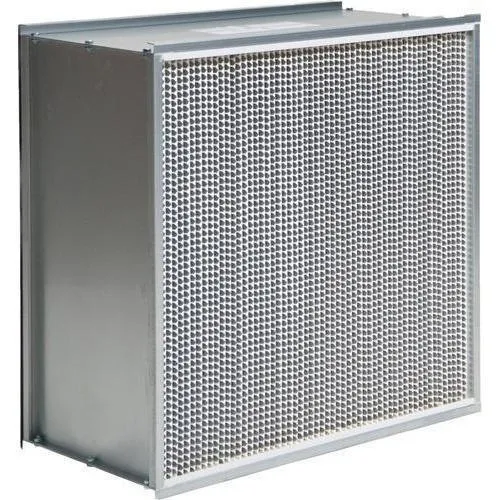
A HEPA (High Efficiency Particulate Air) filter is a highly effective air filtration device designed to capture very small airborne particles. A true HEPA filter can remove 99.97% of particles that 0.3micron in size.
HEPA filters are made from a dense network of fibers, usually fiberglass, which trap particles as air passes through them. These filters are widely used because they provide reliable filtration while maintaining good workflow.
In laboratories, HEPA filters are commonly used in equipment such as:
- Biosafety cabinets
- Laminar airflow cabinets
- Clean benches
- Air purification systems
- Pharmaceutical and medical laboratories
Therefore,
What is a ULPA Filter?
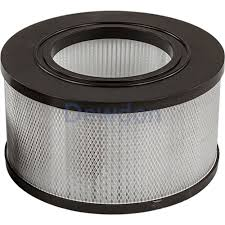
A ULPA ((Ultra Low penetration Air) filter is an advanced type of air cleaning technology that removes at least 99.99% of airborne particles as small as 0.12 microns, including dust, smoke, dust, and bacteria. However, it is designed for highly controlled environments like cleanrooms and laboratories. These filters are more efficient but less effective at airflow than HEPA filters.
Because of their extremely high performance, ULPA filters are typically used in environments that require ultra-clean conditions.
Common places where ULPA filters are used includes:
- Semiconductor manufacturing facilities
- Nanotechnology laboratories
- High-grade cleanrooms
- Advanced Pharmaceutical Production
Therefore, they help to protect laboratory personnel and sensitive experiments from contamination.
How HEPA and ULPA Filters Work?
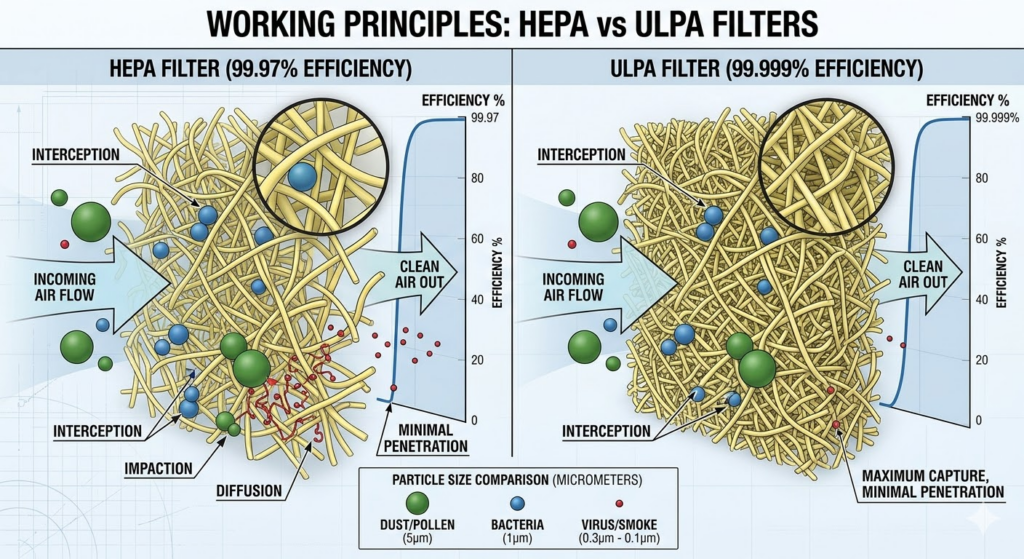
Both HEPA and ULPA filters work using similar filtration principles. As air passes through filters, particles are trapped through several mechanisms:
- Interception: When larger particles carried by the airflow comes in contact with a fiber as it passes. However, Interception captures mid-size particles.
- Initial Impaction: The interaction of the particles is due to Brownian motion or natural movement. Particles below 0.3 microns are trapped during collision with smaller particles (0.1microns).
- Diffusion: Very tiny particles move randomly and eventually stick to the filter fibers.
Key Differences Between HEPA and ULPA Filters
Although HEPA and ULPA filters work in a similar way, there are some important differences between them.
| Features | HEPA Filters | ULPA Filters |
| Filter Efficiency | 99.97% of particles and contaminants are trapped by forcing air through a fine mesh | Trapping 99.999% pf particles and contaminants by forcing air through a fine mesh |
| Particle size | 0.3 microns | 0.12 microns |
| Airflow Resistance | Lower | Higher |
| Cost | More affordable | Expensive |
| Environment | General Lab environment | Ultra-clean environment |
Applications of HEPA and ULPA Filters in Lab Equipment
Both the HEPA and ULPA filters widely use in lab environments to maintain clean air conditions.
HEPA filters are commonly found in:
- Laminar Airflow Cabinets
- Biosafety Cabinets
- Pharmaceutical Laboratories
- Medical and diagnostic Labs
- Educational laboratories
ULPA Filters are specialized filters that are found in:
- Semiconductor manufacturing units
- Microelectronics research labs.
- Bioengineering Labs
- Nanotechnology Labs
- High-level Cleanrooms
- Pharmaceutical Production
Which Filter is Best for Your Laboratory?
Choosing the right filter for your laboratory depends on the type of laboratory work and the level of air cleanliness required. However, HEPA filters are most preferable. They remove 99.97% of airborne particles as small as 0.3 microns, making them suitable for environments that are educational as well as research centers.
Furthermore, some specialized laboratories require a higher level of filtration. In such cases, ULPA filters are more suitable. These are filter 99.999% of particles size of 0.12 microns. These makes it ideal for manufacturing, nanotechnology experiments for semiconductor manufacturing, nanotechnology research, and high-grade cleanrooms where even the smallest particles can affect.
In general, HEPA and ULpa filters meet the needs of most of the laboratory environments.
Conclusion
Air filtration plays a vital role in maintaining laboratory safety, protecting experiments, and ensuring reliable results. Both are are powerful filtration systems that help remove harmful airborne particles. While HEPA filters are suitable for most laboratory applications, ULPA filters provide an additional level of protection for highly specialized environments. Understanding the differences between these two technologies can help laboratories choose the most appropriate filtration system.
If you are planning to set up or upgrade your laboratory equipment, selecting the right filtration system will ensure better safety, performance, and long-term efficiency.



Leave a Reply