Table of Contents
- What is an Autoclave?
- Working Principle of an Autoclave
- Types of Autoclaves Used in Laboratories
- Why Is an Autoclave Important in a Laboratory?
- Conclusion
When it comes to laboratory safety and sterilization, one machine plays a central role in keeping everything clean and free of contamination: the autoclave. Whether you are setting up a school lab, research facility, hospital laboratory, or industrial testing unit, understanding how it works is essential.
At Labkafe, we believe that knowing the science behind your equipment helps you build smarter, safer laboratories. So, let’s break it down interactively.
What is an Autoclave?
An autoclave is a machine used to sterilize laboratory instruments, glassware, media, and other materials using high-pressure steam. In simple words, it is a device that kills bacteria, viruses, fungi, and even resistant spores by exposing them to steam at high temperature and pressure.
However, the idea of steam sterilization was first developed by Charles Chamberland, a colleague of Louis Pasteur, in the 19th century. Today, it is an essential piece of equipment in laboratories, hospitals, research centers, pharmaceutical industries, and educational institutions.
Working principle of an Autoclave
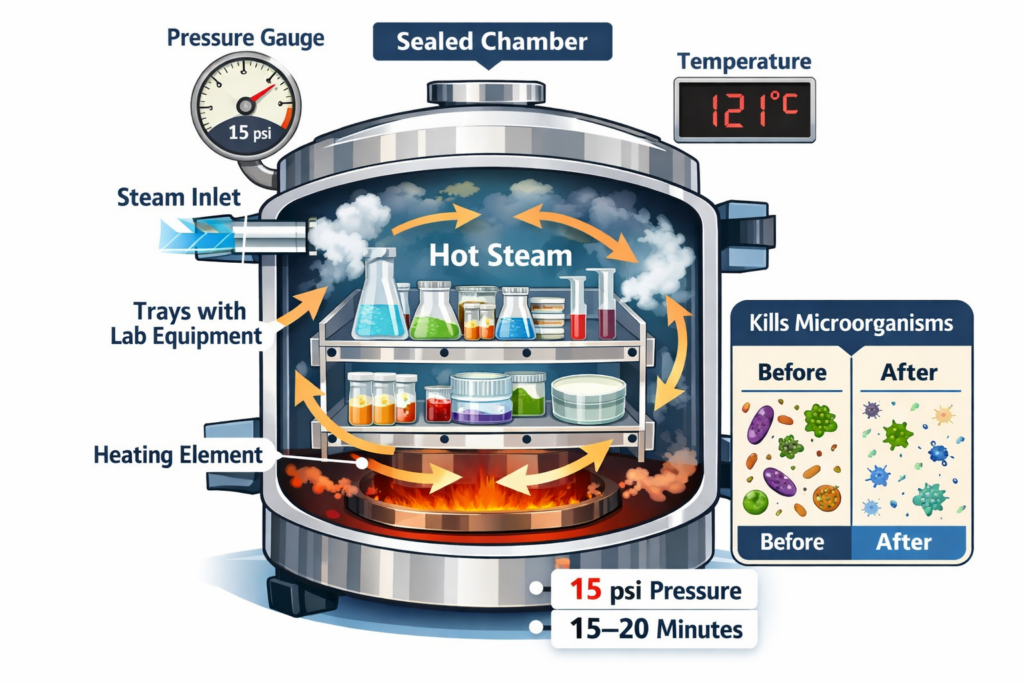
The principle of operation of an autoclave is based on moist heat sterilization using steam under pressure. When water is heated in a closed chamber, the pressure increases, which raises the boiling point of water above 100°C. However, in an autoclave, steam is typically heated to 121°C at 15 psi pressure for about 15–20 minutes.
The high-pressure steam carries strong heat energy. When it comes into contact with laboratory materials, the steam condenses into water and releases latent heat. This heat penetrates the materials and denatures proteins, destroys cell membranes, and kills microorganisms, including bacteria, viruses, fungi, and resistant spores.
Pressure itself does not kill microbes; it allows the steam to reach higher temperatures necessary for effective sterilization. Because steam transfers heat efficiently and penetrate better than dry heat, moist heat sterilization is highly reliable.
Types of Autoclaves Used in Laboratories
There are different types of autoclaves present in the laboratory with a wide variety of purpose:
Laboratory Bench Autoclaves (N-type)
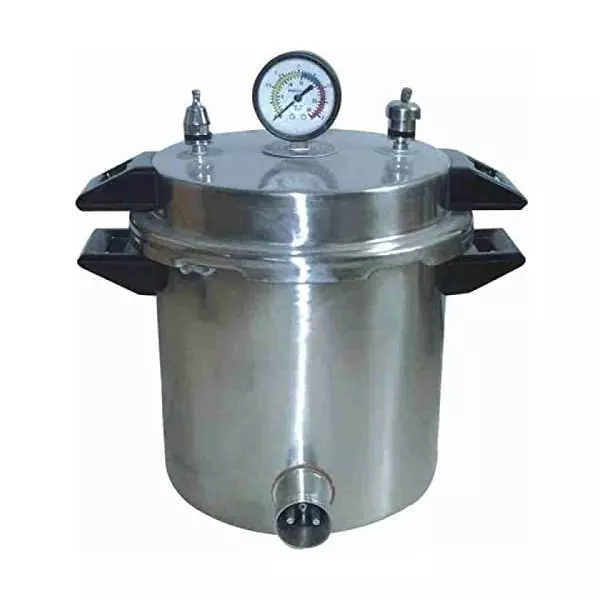
- Many laboratories around the world still use these types, which are similar to domestic pressure cookers.
- They consist of a metal chamber with a secure lid, sealed with a rubber gasket, and often have a pressure gauge, safety valve, and steam/air discharge tap.
- An electric immersion heater at the bottom of the chamber usually heat it
- Used in small-scale sterilization in school labs and basic laboratory settings.
- Simple and cost-effective.
Gravity Displacement Autoclave
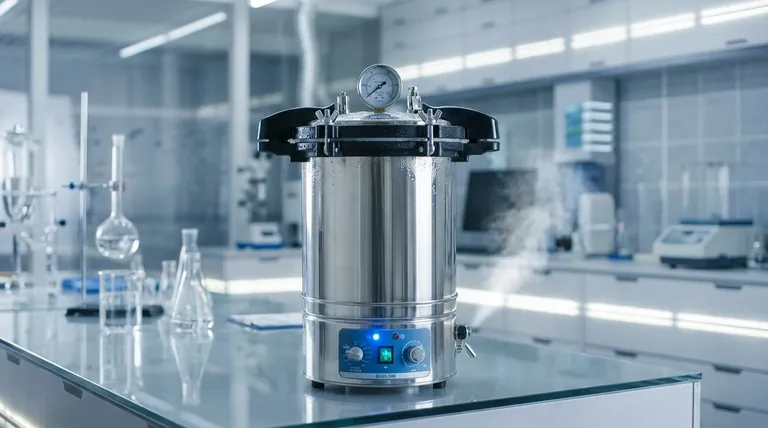
- This type of autoclave is the most common in laboratories.
- The heating unit creates steam inside the chamber and circulates it to sterilize the items.
- The incoming steam displaces the air inside the chamber, which ensures effective sterilization.
- Mainly used in sterilization of liquids, glassware, and routine lab instruments.
- Cheaper and easy to operate compared to other types.
Positive Pressure Displacement Autoclave (B-type)
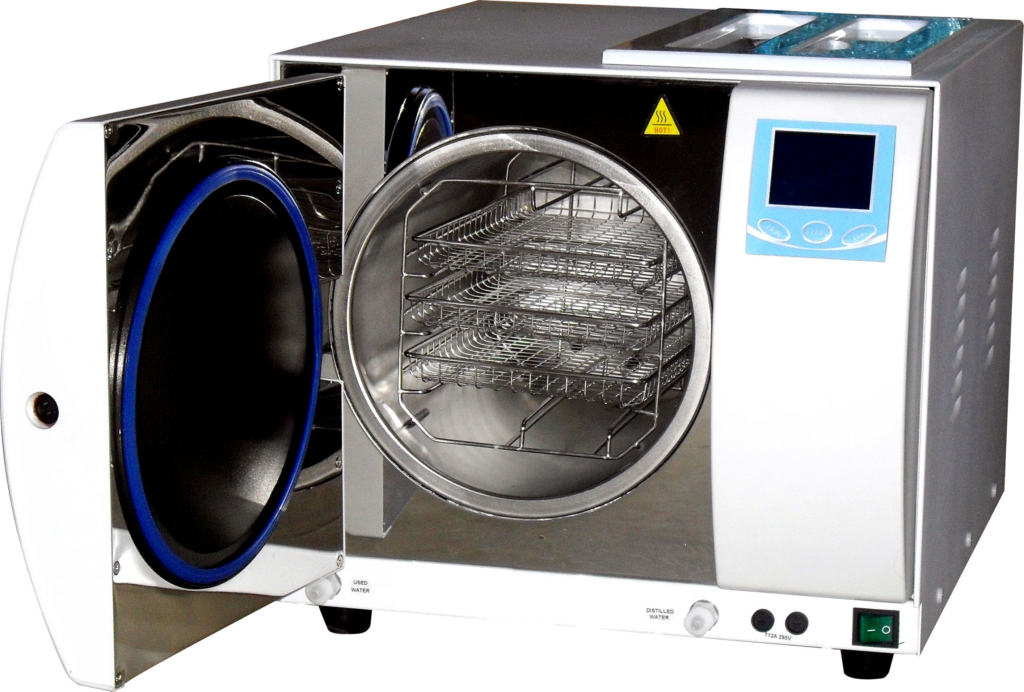
- A separate steam generator produces the steam and then passes it into the device under pressure.
- This allows faster sterilization since steam is produced almost instantly.
- Used in Sterilizing wrapped instruments, culture media, and sensitive lab equipment.
- More efficient than gravity displacement autoclaves.
Negative Pressure / Pre-Vacuum Autoclave (S-type)
- This type contains both a steam generator and a vacuum system.
- The vacuum generator removes air from the chamber before steam is introduced, ensuring complete penetration of steam.
- Mainly used in sterilization of porous materials, culture media, and instruments requiring high sterility assurance.
- Provides the highest sterilization accuracy and is recommended for research labs.
- More expensive than other types.
Why Is an Autoclave Important in a Laboratory?
An autoclave plays a crucial role in maintaining safety and hygiene in a laboratory. Furthermore, it uses high-pressure steam to sterilize glassware, culture media, instruments, and other lab materials. By destroying bacteria, viruses, fungi, and spores, it prevents contamination and ensures accurate experimental results. Without proper sterilization, research outcomes can become unreliable, and harmful microorganisms may spread within the lab.
In addition, an autoclave helps laboratories with safety standards and regulatory guidelines. It protects the lab from exposure to infectious agents and reduces the risk of cross-contamination. However, in school labs or advanced research facilities, an autoclave ensures a clean, safe, and controlled working environment.
Conclusion
An autoclave is an essential piece of equipment in any laboratory. However, it ensures proper sterilization, maintains hygiene, prevents contamination, and protects both experiments and the laboratory. By using high-pressure steam to eliminate harmful microorganisms, an autoclave supports accurate results and a safe working environment.
If you are planning to set up or upgrade your laboratory, invest in a reliable and high-quality, that meets your specific needs. Choose the right type today to ensure safety and long-term performance in your lab.





Leave a Reply